 English
 Spanish
 Galician
 Catalan
 Basque
 French
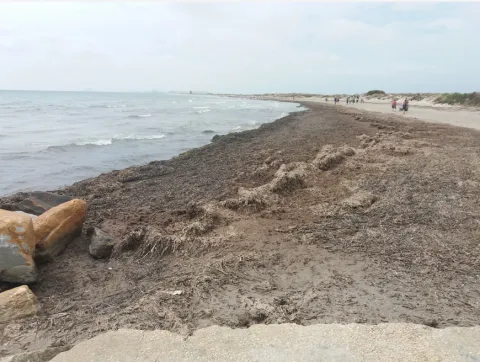
The Official State Gazette has published the Environmental Impact Statement for the La Llana beach development project (San Pedro del Pinatar, Murcia). The aim of this project is to prevent the erosion of 3,000 meters of this dune system, which is of high environmental value.
This intervention, with an estimated budget of €1.17 million, is included in line 3 of the Framework of Priority Actions to Recover the Mar Menor (MAPMM), which contemplates a total investment of €675.05 million, of which €25.3 million are allocated to the environmental recovery of natural spaces in the Mediterranean strip of La Manga del Mar Menor (Puerto Mayor-Caleta del Estacio and dune systems), which are under significant pressure from urban development.
Thus, this project, by the General Directorate of the Coast and the Sea, attached to the Ministry for Ecological Transition and the Demographic Challenge (MITECO), will cover the stretch between the southern breakwater of the port of San Pedro del Pinatar and the area known as Punta de Algas, on the outer fringe of the Salinas y Arenales de San Pedro del Pinatar Regional Park.
These beaches constitute the coastal edge of the sand bar that makes up the northern portion of La Manga del Mar Menor and, in turn, form the dune line that separates the adjacent salt mine from the Mediterranean Sea.
The alteration of the coastal dynamics in the study area, a consequence of the construction of the port of San Pedro del Pinatar, combined with exposure to easterly storms, has caused a progressive and significant regression of the dune ridge on the beaches of La Llana, a situation that has seriously endangered the ecosystems in the area and, consequently, the environmental integrity of the various areas declared in its context.
Therefore, the goal of reconditioning La Llama beach is to prevent erosion along this stretch of coastline through a long-lasting solution, combined with an appropriate maintenance program.
The Commissioner for the Water Cycle and Ecosystem Restoration of MITECO, Francisca Baraza, highlighted the importance and symbolism of this project because, along with the work in La Manga, it will restore the "last vestiges" of the coastal dune zone remaining in the Region of Murcia.
Furthermore, Baraza emphasized that this project responds to a "highly requested" request from the community, as it affects a sandy area "much loved" by local residents and visitors.
This project is essential to ensuring the protection of the regional park's ecosystem and the salt mining activity that takes place there, and therefore the Mar Menor, in addition to restoring an iconic beach for the public.
MITECO has been sensitive to the complicated nature of the intervention, as it is located in a protected area and in zones of high ecological value. The environmental statement has established the conditions for this project to be environmentally sustainable.
The environmental impact study (EIS) highlights, through the analysis of a series of historical orthophotos, the clear recession of the beaches of La Llana since the construction of the port of San Pedro del Pinatar and the gradual increase in width of the Torre Derribada beach, north of the aforementioned port area, a consequence of the barrier effect that the port exerts on the transport of sediment.
The DIA has approved a solution that includes the construction of a 150-meter-long breakwater with a surface area of 1,904 square meters (m2), located perpendicular to the slope of the southern breakwater of the port of San Pedro del Pinatar. The objective is to dissipate the energy produced by the vortices adjacent to the port and maintain a recessed beach.
On the other hand, the MITECO project foresees the contribution of 34,000 cubic meters (m3) of sand from the dry beach and sandbank of Torre Derribada beach without carrying out any type of underwater dredging to obtain the material, with an occupation area of 7,220 m2 of regenerated dry beach and a total occupation area, once the dynamic balance of 26,400 m2 between dry beach, sandbank and submerged beach is reached.
The polygon designed for sand extraction covers 63,600 m2 over a distance of approximately 1.5 km from the Torre Derribada beachfront and avoids direct impact on areas with habitats of community interest (HIC), as well as areas regulated by the Master Plan for Use and Management (PRUG) of the regional park, where earthworks are prohibited as they are classified as "priority conservation areas."
In addition, an environmental improvement plan is included for the dune system from the port of San Pedro del Pinatar to Punta de Algas, complementary to the actions of the LIFE Salinas project.
The DIA has ruled out the construction of a second breakwater, with an area of 295 m2, in Punta de Algas due to its potential significant impact on the Natura 200 ZEC-ZEPA “Salinas y Arenales de San Pedro del Pinatar” area.
Furthermore, the General Directorate of Quality and Environmental Assessment of MITECO determines that these actions will be carried out outside areas with Posidonia oceanica meadows.